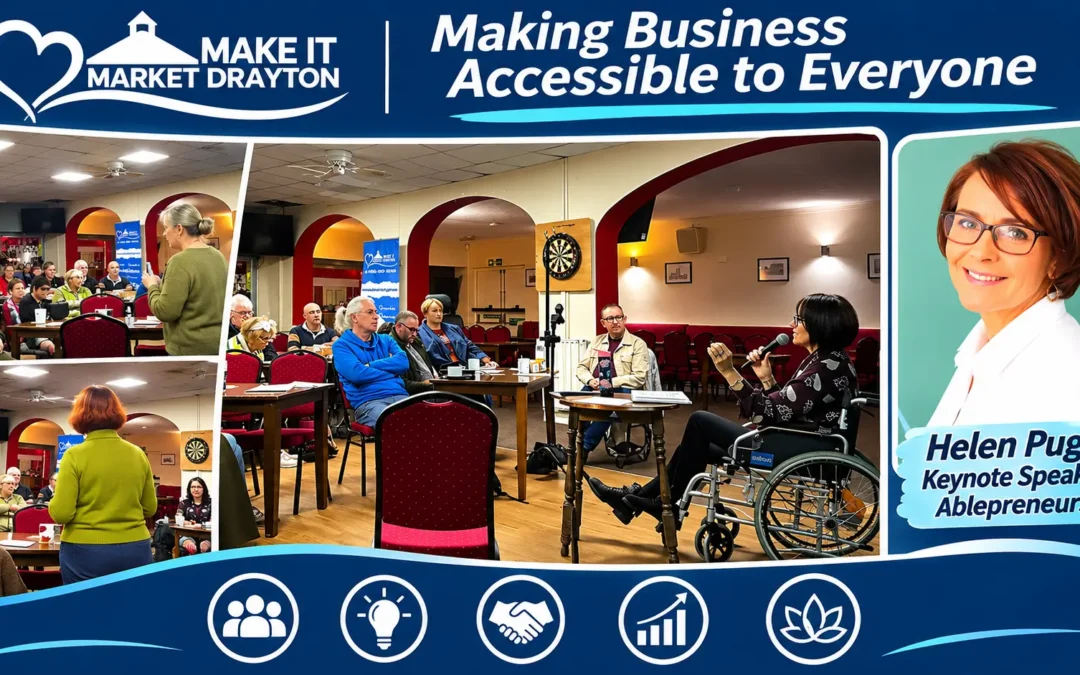
An inspiring evening of personal experiences, practical advice and honest conversations has encouraged Market Drayton businesses to think differently about accessibility, disability and inclusion – with some already planning changes following the event.
Local businesses, community organisations and people with lived experience came together at the Royal British Legion in Market Drayton on Thursday 12 November 2026 for a special Make it Market Drayton Business Networking event, focusing on Making Business Accessible to Everyone.
The free event brought together speakers who shared personal experiences, professional knowledge and practical suggestions to help businesses create more welcoming environments for employees, customers and visitors.
One message emerged throughout the evening: making a business more accessible does not always require expensive alterations or major investment. Sometimes the smallest changes, combined with a willingness to listen and understand, can make the greatest difference.
Supporting the Businesses That Keep Market Drayton Thriving
The evening opened with a welcome from Helen McCabe of Make it Market Drayton, followed by the Mayor of Market Drayton, Councillor Tim Manton.
The Mayor explained why Market Drayton Town Council established the Make it Market Drayton initiative: to raise the town’s profile, attract more visitors and support the independent businesses that are so important to its future.
Local businesses are the lifeblood of Market Drayton. They give people reasons to visit, shop, eat, explore and spend money in the town, supporting jobs and the wider local economy.
Creating an accessible and welcoming town is an important part of that ambition. When more people can comfortably access shops, services, cafés and attractions, the benefits extend beyond individual businesses to the whole community.
Starting the Evening with a Moment to Breathe
Rachel Foster began the presentations with a gentle breathing exercise, encouraging everyone to take a moment to relax and focus on their breathing.
She explained how something as simple as becoming more aware of our breathing can help us manage stress, feel calmer and approach situations with greater clarity.
It was a thoughtful introduction to an evening that encouraged businesses to consider not only physical accessibility but also people’s emotional wellbeing and individual needs.
Living with a Stoma – Understanding Needs That Are Not Always Visible
One of the evening’s particularly inspiring contributions came from Candice, who spoke openly about living with a stoma and the monthly Stoma Support Group she established.
Her personal experiences provided valuable insights into challenges that many people may never have considered.
Candice explained how employers can better support colleagues who have a stoma, including recognising that they may need additional time, privacy or suitable facilities during the working day.
She also highlighted the importance of appropriate toilet facilities and explained how stoma-friendly toilets can make an enormous difference to people’s confidence when visiting shops, restaurants and other public places.
An accessible toilet is not necessarily fully equipped for someone with a stoma. Practical considerations can include suitable disposal facilities, a shelf for supplies, hooks for clothing or bags and access to a washbasin.
Candice praised Market Drayton as one of the friendliest towns she has experienced for stoma-friendly toilet facilities, something that those attending were particularly pleased to hear.
Her contribution was also an important reminder that not all disabilities or medical conditions are immediately visible.
For local businesses, the message was straightforward: never assume that someone does not need additional support simply because their condition cannot be seen.
Menopause in the Workplace – Why Conversation Matters
Denise McGowan, a Menopause Doula, discussed a subject that can have a significant impact on workplaces but is still too often overlooked.
She explained how women experiencing perimenopause and menopause may face challenges that affect their comfort, confidence and wellbeing at work.
Many women over 45 are highly experienced employees, managers and business leaders. Supporting them through this stage of life can help businesses retain valuable skills, knowledge and experience.
Denise encouraged employers to talk openly with their female employees rather than making assumptions about what they might need.
Importantly, she explained that workplace adjustments do not always have to be expensive.
Something as simple as providing a desk fan, allowing greater flexibility or considering the temperature of a working environment can make a considerable difference.
The most important starting point is creating a workplace where women feel comfortable discussing their needs and where those conversations are met with understanding rather than embarrassment.
Her advice offered a practical reminder that a supportive working environment benefits both employees and employers.
Accessibility Is Good for People – and Good for Business
Sarah-Jane Lamb of Accessible Places UK delivered an informative presentation exploring the importance of accessibility for businesses, visitor attractions and the wider tourism economy.
Drawing on lived experience and professional expertise, Sarah-Jane explained that accessibility is about far more than wheelchair ramps and accessible entrances.
It involves creating places, services and experiences that people with a wide range of needs can access and enjoy with confidence.
These needs can include mobility difficulties, hearing or sight loss, dementia, neurodivergence and other conditions that may affect how people experience a business or public space.
Her presentation highlighted that approximately one in four people in the UK are disabled, representing around 16.8 million potential customers and visitors.
She also discussed the considerable spending power of disabled people and their households, often referred to as the Purple Pound, and the growing importance of older consumers, sometimes described as the Silver Pound.
The presentation highlighted figures including £274 billion in spending power associated with disabled people and their households and an estimated £14.6 billion annual value for accessible tourism in the UK.
These figures, shared during the presentation, illustrated why accessibility should be considered an important business opportunity rather than simply an additional expense.
The Whole-Party Advantage
Sarah-Jane highlighted an important consideration for businesses.
If a customer cannot access a shop, restaurant or visitor attraction, it is not necessarily just that customer’s business that is lost.
Their family, friends or wider group may choose to go elsewhere too.
She described this as the whole-party advantage: when businesses become more accessible, they can attract not just one additional customer but the people accompanying them.
For a town such as Market Drayton, which is actively encouraging more people to visit, improving accessibility presents an opportunity to strengthen the local visitor economy.
Practical Steps Businesses Can Take
Sarah-Jane encouraged businesses to review their premises and services from the perspective of people with different access needs.
Useful starting points include considering how easily someone can enter a building, whether information is clear and easy to understand, how staff communicate with customers and whether accessibility information is available before someone visits.
She outlined five important steps towards greater accessibility:
- Commission an accessibility audit of your premises or facilities.
- Provide accessibility awareness training for staff and volunteers.
- Develop partnerships that help create more inclusive experiences.
- Regularly review accessibility and identify opportunities for improvement.
- Provide an accessibility guide explaining what facilities and services are available.
Clear information can be particularly valuable. For example, if a business has steps at its entrance or limited accessible facilities, explaining this in advance helps customers make informed decisions about visiting.
Sarah-Jane’s presentation reinforced that improving accessibility benefits not only disabled people but also older visitors, families, carers and the wider community.
Businesses can learn more about her work at www.accessibleplacesuk.com.
Supporting Young People and People with Disabilities into Training and Employment
Melissa Tharm from Fox Training introduced the work undertaken to provide training and support, including helping people with disabilities develop skills and opportunities.
She was accompanied by Maddie, one of the organisation’s young students, who quickly became a favourite with everyone attending.
Their contribution helped demonstrate the importance of recognising individual abilities, building confidence and providing the right support to help people develop their potential.
For employers, it was another reminder that creating an inclusive workplace can open opportunities for people whose talents and abilities might otherwise be overlooked.
Helen Pugh – Creating Workplaces Where Everyone Can Thrive
The evening’s keynote speaker was Helen Pugh, founder of Ablepreneurs and author of The Ablepreneur Advantage.
Helen, a Theo Paphitis Small Business Sunday (#SBS) winner and recognised among Small Business Britain’s Top 100 Female Entrepreneurs for 2026, delivered a powerful and inspiring presentation about the barriers faced by people living with disabilities, chronic pain, long-term illness and neurodivergent conditions.
Drawing on her experience, she challenged businesses to reconsider how they respond when an employee develops a life-changing health condition or needs additional support.
Too often, she explained, the immediate question becomes whether that person can still do their job.
Helen encouraged employers to approach the situation differently.
Instead of asking whether someone can still do their job, ask what changes can be made to help them thrive.
That change in thinking was one of the strongest messages of the evening.
Rather than focusing on what someone cannot do, businesses should consider how the working environment, expectations or arrangements could be adapted to help them succeed.
Helen discussed how relatively simple adjustments can remove barriers, including flexible working hours, changes to working arrangements and greater understanding of individual needs.
For someone living with chronic pain, fatigue or a fluctuating medical condition, flexibility may make the difference between being able to continue working and feeling excluded from employment.
For neurodivergent employees, understanding how they work best and adapting communication or workplace practices can help them use their skills and abilities more effectively.
Helen also reminded businesses that disability is not always physical or visible.
The aim should not simply be to accommodate people but to create environments in which everyone has the opportunity to contribute, succeed and thrive.
Helping Businesses Retain Valuable Employees
Helen introduced some of the support available through Ablepreneurs, including its Retain and Thrive approach, which helps businesses prepare for and respond when employees develop disabilities or chronic health conditions.
She also highlighted the importance of looking at businesses through a different lens to identify barriers that may prevent people from accessing employment, products or services.
Her message extended beyond employment to the experiences of customers and visitors.
Businesses that listen, remove unnecessary barriers and create welcoming environments can make a positive difference to individuals while strengthening their own organisations.
More information is available at www.ablepreneurs.co.uk.
A Town Willing to Have Important Conversations
Closing the speaker presentations, Councillor Tim Manton praised everyone who had contributed and welcomed the fact that these important conversations were taking place in Market Drayton.
He was particularly encouraged to hear positive experiences of the town’s accessibility, including the recognition of its stoma-friendly toilet facilities.
The evening demonstrated that accessibility is not simply a matter of compliance or providing particular facilities.
It is about understanding people’s experiences, recognising barriers and working together to make improvements.
The networking session that followed gave attendees the opportunity to continue those conversations, make new connections and explore ideas for their own businesses.
Businesses Already Planning Changes
Perhaps the most encouraging outcome of the evening was hearing that the presentations had already inspired local businesses to take action.
Jeni from Healing Arts Number 5, on Market Drayton High Street, explained that she had learned a great deal from the speakers and was already planning to introduce changes to make her business more accessible and welcoming for both customers and employees.
Her response demonstrated exactly what the evening was designed to achieve – turning greater awareness and understanding into practical improvements that can make a real difference.
Feedback from others attending was equally enthusiastic.
Jemma commented:
“Thank you @Helen Mccabe for an enjoyable and memorable evening. So much information and experiences were shared. It’s proof that small changes can make a huge difference to so many people.”
Tony from Tranquil Still Ltd said:
“Some excellent education from this evening; thanks a lot to all the speakers and all the very best in achieving the changes you are promoting.”
Denise McGowan added:
“Huge thank you for a fab networking event this evening @Helen Mccabe and team.”
Councillor Tim Manton also reflected on the event from his perspective as a local business owner:
“I’ll take my Mayor hat off, and say, as a business owner, tonight was enlightening.”
Another attendee described the evening as extremely informative and suggested that the knowledge shared should reach businesses that were unable to attend.
That feedback reflects one of the wider aims of Make it Market Drayton: ensuring that useful information, learning and opportunities can benefit businesses throughout the town, not just those attending individual events.
What Can Your Business Do Differently?
You do not need to have attended the event to begin making positive changes.
Whether you run a small independent shop, café, professional service, hospitality business or larger organisation, there are practical steps worth considering.
Here are ten ideas to get started:
- Ask your employees what they need. Do not assume everyone works best in the same environment or under the same arrangements.
- Review your entrance and customer areas. Consider steps, heavy doors, narrow spaces, seating and other potential barriers.
- Think about invisible disabilities. Remember that people may have conditions or access needs that are not immediately apparent.
- Consider flexible working arrangements. Small changes to hours, breaks or working patterns can make employment more accessible.
- Make menopause a comfortable subject to discuss. Simple adjustments and supportive conversations can help retain experienced employees.
- Review your toilet facilities. Consider the needs of people with stomas and other medical conditions, not only wheelchair accessibility.
- Make information easy to access. Clear signage, readable menus, accessible websites and accurate information about facilities help customers plan their visits.
- Help staff understand different needs. Awareness and appropriate training can improve the experience of both employees and customers.
- Listen to people with lived experience. Their insights can identify barriers that business owners may never have considered.
- Start with one change. You do not have to do everything immediately. Identify one practical improvement and build from there.
The most important lesson from the evening was that accessibility is not about treating everyone identically. It is about understanding that people have different needs and ensuring those differences do not become unnecessary barriers.
Working Together for a More Accessible Market Drayton
Market Drayton has much to be proud of, from its independent businesses and welcoming community to the people and organisations already working to make the town more inclusive.
The networking evening demonstrated the value of bringing businesses together with people who can share their lived experiences and professional knowledge.
It also highlighted that conversations about accessibility should not be confined to a single event.
By continuing to listen, learn and make practical improvements, local businesses can help ensure Market Drayton remains a town where more people feel welcome, whether they live here, work here or are visiting for the first time.
Make it Market Drayton would like to thank all the speakers, everyone who attended and contributed to the discussions, Councillor Tim Manton and the Royal British Legion for hosting the evening.
Were you at the event? Have you made a change to your business, or is there something you are now considering? We would love to hear about it.
Businesses interested in future networking events, workshops and training opportunities can find further information at www.makeitmarketdrayton.com.
Make it Market Drayton is a town council initiative.